Should we charge for deliverance ministry?
July 25, 2026
I think it is the wrong question...
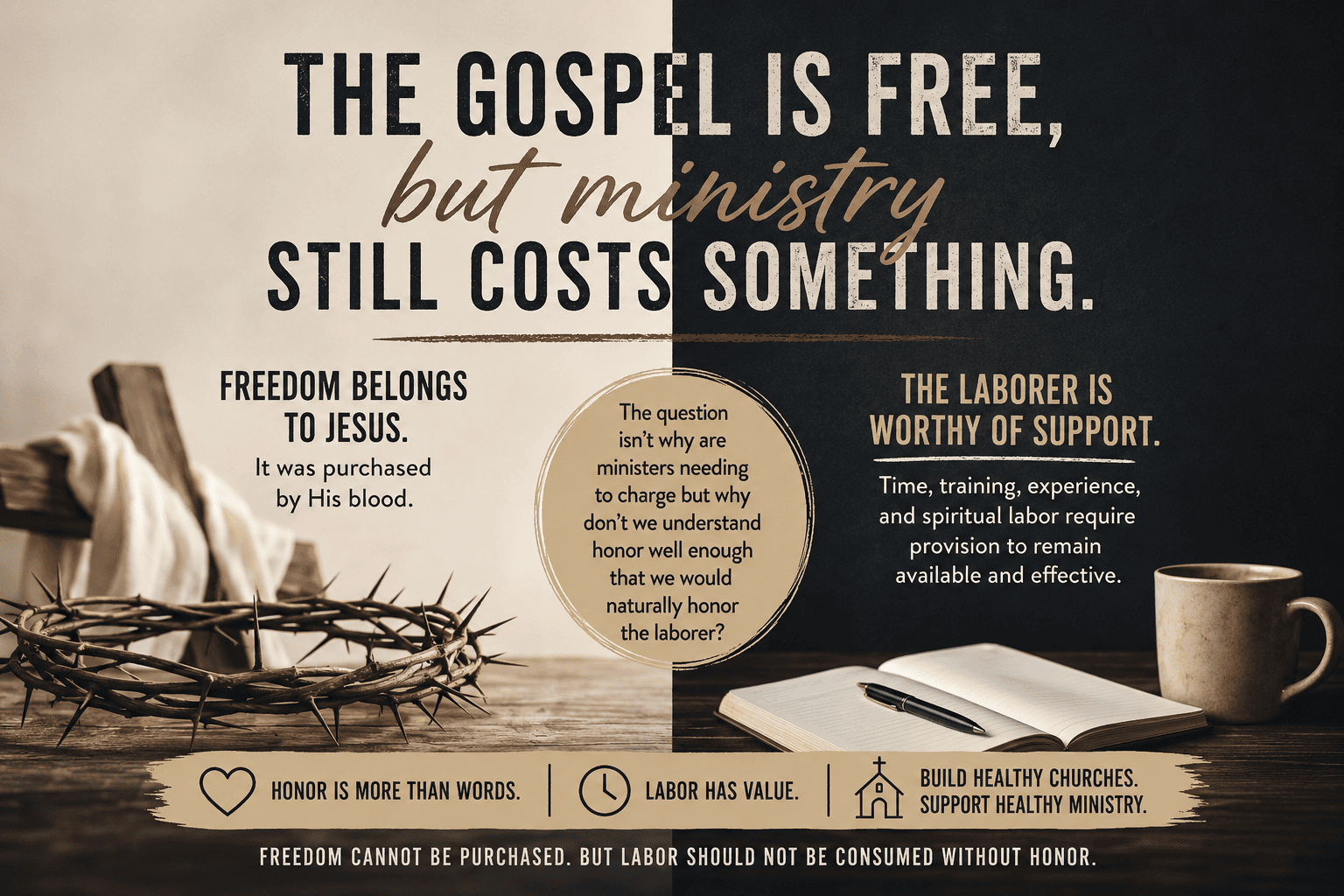
There is a difference between charging someone for freedom and honoring a laborer who has invested their life into helping people walk into it.
That distinction matters.
Deliverance was never meant to become a spiritual marketplace where vulnerable people are made to believe that greater payment purchases greater power, greater access, or a more certain breakthrough. The power belongs to Jesus. Freedom was purchased by His blood. No minister owns the anointing, and no one has the right to sell what only Christ could provide.
Jesus said, “Freely you received, freely give” (Matthew 10:8).
That truth must remain firmly established.
At the same time, that verse cannot be interpreted in a way that ignores everything else Scripture teaches concerning labor, provision, support, and honor. The same Bible that warns us against merchandising spiritual power also says, “The laborer is worthy of his wages” (Luke 10:7).
Paul asked, “Who at any time serves as a soldier at his own expense?” He then spoke of the farmer, the shepherd, the ox, and the priest, all receiving provision from the field in which they labor. His conclusion was direct: “The Lord directed those who proclaim the gospel to get their living from the gospel” (1 Corinthians 9:7–14).
The problem is not that money and ministry ever touch.
The problem is when money governs ministry.
There is a difference between receiving support because you labor and withholding ministry until someone purchases access to the gift. There is a difference between an honorarium and a fee for anointing. There is a difference between providing a structured, supported ministry session and turning desperate people into customers.
We need enough maturity to recognize that difference.
The Western Divorce of Honor and Finances
In much of Western Christianity, we have separated the language of honor from its practical expression.
We say we honor someone, but often mean that we appreciate them emotionally, speak well of them publicly, or thank them after they have poured themselves out. Those things matter, but biblical honor was rarely abstract. It regularly carried a material expression.
To honor someone was to treat their contribution as weighty and valuable, then respond accordingly.
Paul wrote, “The elders who lead well are to be considered worthy of double honor, especially those who work hard at preaching and teaching.” He immediately supported that statement by saying, “You shall not muzzle the ox while it is threshing,” and, “The laborer is worthy of his wages” (1 Timothy 5:17–18).
Paul did not separate honor from provision.
He connected them.
When Scripture commands children to honor their father and mother, Jesus later confronts religious leaders who used spiritual language to avoid materially caring for their parents. They declared their resources “Corban,” dedicated to God, while refusing to provide for those they were commanded to honor. Jesus said their tradition had invalidated the word of God (Mark 7:9–13).
Apparently, biblical honor that never reaches our resources can become little more than religious language.
Honor is not always money, but biblical honor frequently carries financial weight.
Very often, finances reveal whether honor is merely spoken or actually carried.
Why Does the Minister Have to Ask?
The deeper question may not be, “Why do ministers feel the need to charge?”
The deeper question may be, “Why has our understanding of honor become so weak that we could allow someone to spend three or four hours praying, listening, discerning, preparing, and investing in our breakthrough without it naturally occurring to us to honor them financially?”
In a healthy culture of honor, the minister should not always have to force that conversation. The recipient should already understand that significant labor deserves a significant response.
The need for structured fees may sometimes reveal more than a minister’s financial model. It may reveal that people have learned how to receive substantial ministry without carrying any personal responsibility for sustaining those who provide it.
We would not allow someone to spend hours repairing our vehicle, working on our home, counseling our family, or addressing a complicated legal issue without expecting to honor their time and expertise. Yet when the labor is spiritual, people can suddenly believe that expecting any financial response contaminates the ministry.
That is not always conviction.
Sometimes it is entitlement.
Perhaps the goal is not merely to eliminate charging. Perhaps the goal is to restore such a mature culture of honor that ministers no longer have to choose between awkwardly discussing finances and quietly carrying the cost of everyone else’s breakthrough.
“Freely You Received” Does Not Mean Nothing Cost the Minister
“Freely you received, freely give” must remain part of this conversation, but it must also be interpreted honestly.
Jesus was instructing His disciples not to merchandise the authority He had freely entrusted to them. They did not purchase the power to heal the sick, cast out demons, cleanse lepers, or announce the Kingdom. Because the authority came from Christ as a gift, they could not treat the anointing as a product they owned and then sell access to it.
But that does not mean everything surrounding mature ministry was received without cost.
The authority may have been freely given, but the labor required to steward that authority faithfully is costly.
Many deliverance ministers have invested years into biblical education, ministry training, pastoral development, trauma awareness, counseling skills, supervised ministry, theological study, and learning how to distinguish spiritual oppression from emotional, relational, psychological, or medical issues.
They have paid for courses, books, conferences, certifications, mentoring, travel, and continuing education. More importantly, they have invested thousands of hours ministering to people, learning through experience, developing discernment, recognizing patterns, and gaining the maturity required to handle difficult cases without damaging vulnerable hearts.
None of that purchases the power of God.
It prepares the person to steward people responsibly while ministering in the power of God.
We understand this distinction in almost every other field.
A physician does not charge because they created the human body or possess the power of life. They are compensated for the education, training, judgment, time, and responsibility required to care for it.
A counselor does not own emotional healing. They are compensated for the education and labor involved in helping someone navigate a complicated process wisely.
Deliverance ministers should never pretend that education gives them authority over demons. Christ gives authority. But education, experience, accountability, and spiritual formation can help a person exercise that authority without becoming reckless, simplistic, or harmful.
The power was freely received.
Expertise was developed through costly stewardship.
Those truths do not contradict one another.
“Freely give” should prevent ministers from selling the anointing. It should not become a verse people use to avoid honoring the labor required to steward that anointing responsibly.
Deliverance Ministry Requires Real Labor
Healthy deliverance ministry is not merely someone shouting at a demon for fifteen minutes.
It often involves preparation, prayer, discernment, listening, teaching, repentance, renunciation, follow-up, documentation, communication, and careful stewardship of a person’s heart.
Some sessions require several hours. Some situations demand a trained team. Some ministers remain available before and after the appointment because freedom is not always contained within a single moment. Sometimes freedom requires a process of truth, discipleship, healing, renewed thinking, restored relationships, and reordered living.
There is spiritual labor involved.
There is emotional labor involved.
There is administrative labor involved.
There is time involved.
There is often a cost to the minister’s family, schedule, energy, and personal capacity.
To acknowledge that labor is not the same as believing someone can buy freedom.
A church pays pastors because shepherding requires sustained labor. Churches pay administrators, worship leaders, media staff, children’s workers, counselors, and ministry directors because ongoing work requires ongoing provision.
We do not normally accuse a pastor of selling sermons because the church pays a salary. We understand that the congregation is supporting the laborer so the laborer can remain available to fulfill the assignment.
Deliverance ministry should not automatically be treated differently simply because the work is spiritual and the need is urgent.
The laborer still eats.
The laborer still has a family.
The laborer still has bills.
The laborer still has a finite number of hours.
Demanding that someone give unlimited ministry while refusing to consider how that ministry will be sustained is not always faith. Sometimes it is consumption dressed in spiritual language.
The Need Is Greater Than the Number of Laborers
The demand for mature deliverance ministry currently far outweighs the number of healthy, trained, accountable ministers available to provide it.
Jesus said, “The harvest is plentiful, but the workers are few” (Matthew 9:37).
That reality is especially visible in deliverance.
When only a small number of people are equipped to carry complicated cases, their schedules quickly become overwhelmed. A minister may spend three or four hours in one session, then devote additional time to preparation, follow-up, team development, administration, prayer, and communication with pastors or family members.
A minister can volunteer around the edges of another full-time life for only so long before capacity becomes the issue.
At some point, supporting the laborer is what makes greater availability possible.
Financial honor can allow someone to reduce secular employment, continue their education, train additional ministers, build a qualified team, provide appropriate follow-up, and create room in their schedule for the growing number of people seeking help.
That is not necessarily charging for the authority of Christ.
It may be the practical structure required to keep a trained laborer in the field.
We cannot complain that there are not enough mature deliverance ministers while simultaneously refusing to create structures that allow mature deliverance ministers to devote meaningful time to the work.
The laborers are few, in part, because we have not learned how to sustain them.
When Ministry Requires a Structure
I also think we need to be careful when discussing the way deliverance ministers package and present their ministry.
Personally, I do not feel comfortable using many of the marketing mechanisms commonly used in the business world to promote ministry. That is a conviction I carry for myself, particularly when the people seeking help may already be vulnerable, desperate, or in pain.
At the same time, I do not believe every minister who uses those methods is necessarily trying to commercialize the anointing or exploit people.
In many cases, they may simply be trying to create enough structure and visibility to give themselves fully to a calling that would otherwise remain unsupported.
The need for deliverance ministry is significant, while the number of mature, trained, and available ministers remains limited. Many of those ministers have invested years into education, training, experience, team development, and learning how to handle complicated situations responsibly.
They may deeply desire to devote their lives to that assignment, but passion alone does not provide for their families or create the capacity to maintain a demanding ministry schedule.
When a healthy culture of honor is absent, ministers often turn to the models they understand.
They create programs, organize sessions, explain outcomes, communicate costs, and use marketing tools to reach the people who need what they carry. While I may not personally choose to package ministry in that way, I can understand why some believe it is necessary.
The issue is not simply whether ministry has been structured or marketed.
The deeper questions concern motive, integrity, transparency, and fruit.
Is the minister creating clarity or manufacturing pressure?
Are they helping people understand the process or promising outcomes only God can guarantee?
Are they communicating the value of their time and training, or presenting spiritual freedom as a product that can be purchased?
Are they using available tools to sustain a legitimate calling, or exploiting fear and desperation?
Those distinctions matter.
A ministry can be well organized without being manipulative. It can communicate clearly without commodifying spiritual power. It can charge for time, training, administration, and structured care without pretending that the anointing itself belongs to the minister.
I may still prefer a model where honor, church partnership, and relational support make aggressive marketing unnecessary. But until that culture is more fully restored, I think we should be cautious about judging every minister who has built a structured financial model around their work.
Some may simply be trying to remain available to the people they feel called to serve.
The minister must guard their heart from commercialization.
The Church must examine whether its lack of honor helped make the structure necessary.
Deliverance Belongs in Healthy Churches
I believe deliverance ministry is meant to function within healthy local churches.
Not as a strange department hidden in the back hallway. Not as an independent personality building a following around demons. Not as a disconnected ministry operating without pastoral oversight, theological accountability, or relational follow-up.
Deliverance belongs within the larger work of making disciples.
People need more than something cast out. They need truth established, patterns confronted, wounds healed, relationships restored, habits changed, and spiritual disciplines developed.
They need shepherds.
They need community.
They need the ministry of the Word, the presence of the Holy Spirit, and a healthy body around them.
The healthiest environment is a church mature enough to recognize deliverance as part of the ministry of Jesus and responsible enough to support those assigned to carry it.
When a church expects a person to conduct multiple sessions every week, prepare teams, train leaders, provide follow-up, and remain available for complicated cases, that is no longer occasional volunteer service.
It has become a legitimate ministerial assignment.
Assignments that consume substantial time should eventually receive substantial support.
Churches already understand this concerning preaching, worship, children’s ministry, administration, counseling, media, and pastoral care. Yet deliverance workers are often expected to carry some of the most demanding cases in the church without compensation because their work is considered something spiritual people should simply do for free.
That is not always honor.
Sometimes it is a failure of structure.
We Are Outsourcing What We Have Not Yet Built
The tension becomes more complicated because many churches have not developed healthy deliverance ministry.
Some do not believe in it.
Some believe in it but have no trained teams.
Some attempted it carelessly and produced fear, confusion, or harm.
Others quietly refer difficult cases elsewhere because they do not possess the time, confidence, maturity, or experience to address them internally.
Because the local church has not fully integrated deliverance, people seek help from independent ministers who have spent years developing experience in this area.
Those ministers are then expected to carry what churches have outsourced, but often without the support churches provide to their own staff.
That arrangement is not sustainable.
An independent deliverance minister may be carrying the responsibilities of a pastor, counselor, intercessor, administrator, teacher, and ministry team while receiving none of the structural support normally given to those roles.
Then the same church culture that refers people to them may criticize them for requiring financial honor.
We have to be honest about that contradiction.
If the Church is outsourcing the work, then the Church should not be surprised that outside ministries must build structures capable of sustaining it.
Until local churches develop mature, accountable, and well-supported deliverance ministries within healthy houses, there will continue to be a need for trusted ministries that serve beyond the walls of a single congregation.
Those ministries should remain accountable.
Their financial practices should be transparent.
Their leaders should be doctrinally sound.
They should never exploit desperation.
But they should not be expected to live on appreciation alone.
The Danger on Both Sides
There is a ditch on both sides of this road.
On one side, ministers can commercialize freedom. They can create dependency, exaggerate spiritual conditions, promise guaranteed outcomes, pressure people financially, or build a brand around their supposed authority over darkness.
Simon the magician attempted to purchase spiritual authority, and Peter rebuked him severely (Acts 8:18–23).
Gehazi pursued personal gain from a miracle Elisha had freely ministered, and his greed brought judgment upon him (2 Kings 5:20–27).
The anointing is not for sale.
The gifts of God are not merchandise.
Vulnerable people must never be manipulated.
But on the other side, recipients can dishonor labor, consume ministry without gratitude, demand immediate access, resist healthy boundaries, and judge anyone who discusses financial support as though money itself contaminates ministry.
That is also unhealthy.
Women materially supported the ministry of Jesus and His disciples (Luke 8:1–3). Paul received financial partnership from churches. The Philippians repeatedly sent support to him, and he described their giving as “a fragrant aroma, an acceptable sacrifice, pleasing to God” (Philippians 4:15–18).
Financial partnership did not corrupt the ministry.
It helped sustain it.
A Healthier Middle
The answer is not to place a price on freedom.
The answer is to build honorable systems around labor.
A healthy deliverance ministry should never communicate that a person’s ability to pay determines whether Jesus is willing to set them free. Churches and ministries should make room for generosity, scholarships, benevolence, sponsorship, and ministry to those who genuinely cannot contribute.
At the same time, people who are able to honor the labor should not assume that receiving several hours of focused ministry carries no practical cost.
The minister should not manipulate.
The recipient should not presume.
The church should not outsource responsibility without helping carry the burden.
When possible, local churches should develop trained teams and financially support those who carry a significant ongoing assignment. When outside ministries are needed, churches should consider helping cover the cost rather than sending struggling people away to navigate everything alone.
This allows deliverance to remain ministry rather than merchandise while allowing laborers to remain healthy, available, and sustainable.
The question is not merely, “Did money change hands?”
The better questions are these:
Was the anointing being sold, or was labor being honored?
Was vulnerability exploited, or was a trustworthy structure provided?
Was access to freedom withheld from the poor, or was provision made for those in need?
Was the minister building dependence upon themselves, or helping people return to Christ, truth, community, and healthy discipleship?
Was the financial expectation hidden and manipulative, or clear, reasonable, and accountable?
Was the recipient being treated like a customer, or was the laborer simply being sustained in their assignment?
Those questions bring us much closer to the biblical middle.
We should fiercely protect the truth that freedom cannot be purchased.
We should also recover the truth that labor should not be continually consumed without honor.
The gospel is free.
The authority of Christ is freely given.
Mature stewardship is costly to develop.
Ministry still costs something.
The power belongs to God.
The laborer is still worthy of support.
A mature Church must be able to hold all of those truths at the same time.
Support This Ministry
If this content has blessed you, consider partnering with us to reach more lives with the Gospel.
Partner with Us